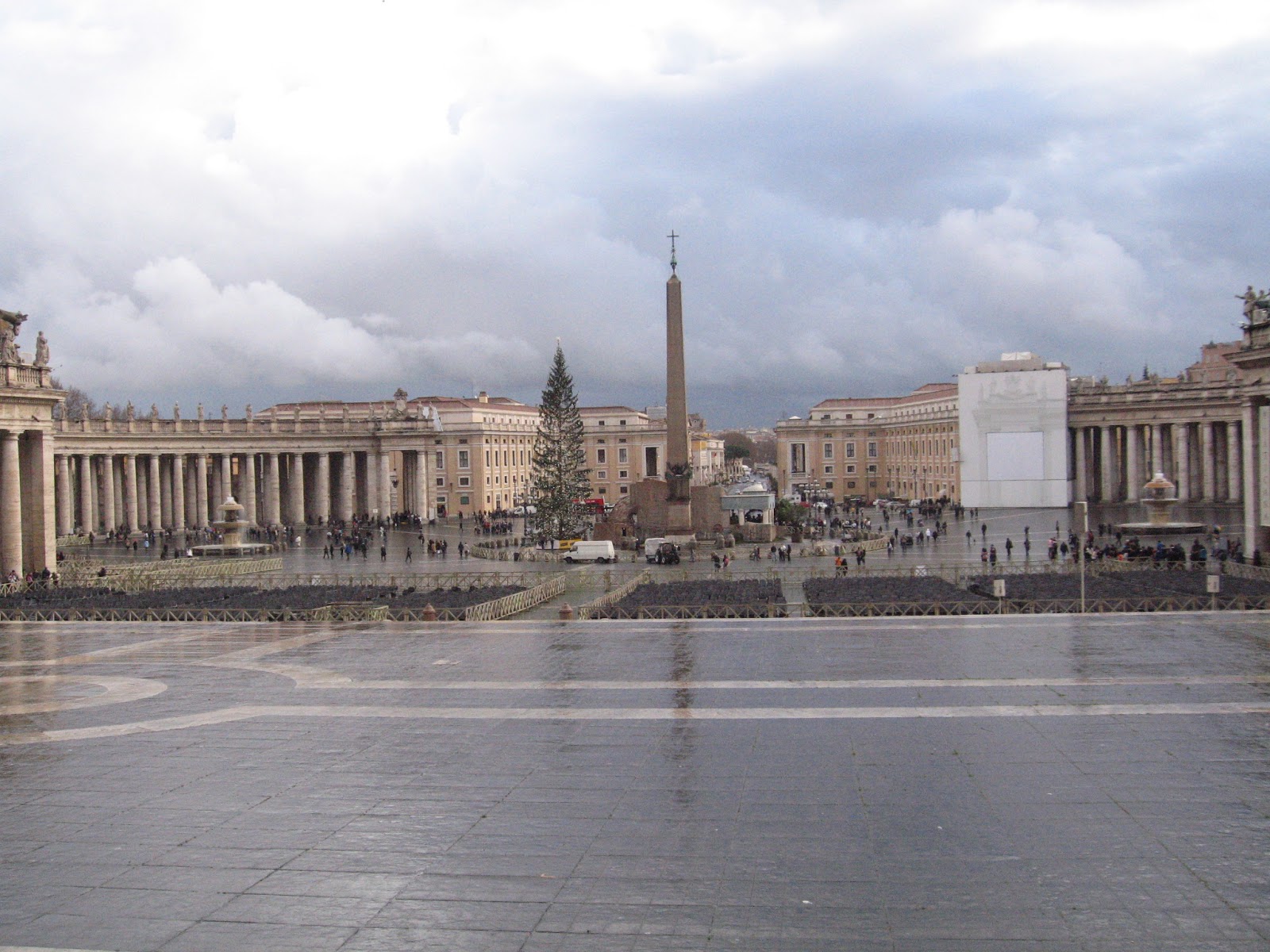
Where does one go on a rainy Christmas Eve in Rome? The Vatican, of course, and St. Peter's.
I misjudged how long it would take me--a bit of overconfidence in my Rome navigation skills--so got to the Vatican too late for my tour. So at half past 9, after wandering in something of a daze in St. Peter's Square (which isn't at all square, by the way, but a huge piazza), I joined the relatively short line to enter St. Peter's Basilica; my wait was only about 5 minutes. If you go to St. Peter's, be prepared to be in awe. And be forewarned that this is not a short jaunt. You will want to allow plenty of time to see the Basilica and then tour the Vatican Museum.
Fortunately, I'd spent a little time getting familiar with the place before I visited it. Even still, reviewing the
floorplan did not prepare me for the actual experience. What I wish I'd spent some time reading is this
guide to the Basilica because of the explanations of the doors as well as everything else. I wish I'd known about it because, had I had the time, having this recorded and downloaded on my iPod would have made one terrific audioguide. Fortunately, there is information available throughout the Basilica, so I wasn't completely uninformed about what was making me "ooh" and "ahh."
The portico, before you even get to the massive doors to enter St. Peter's, requires a moment to stop and look up. If you learn nothing else from me, learn this: in any church or any museum in Rome, look up. Seriously. I mean it. This isn't too much to see and gasp about just yet, but then you enter those huge, heavy doors and you will likely stop in your tracks, which means people behind you who are also gaping will run right into you.
You will be told, no doubt. that St. Peter's is the biggest church in the world. Apparently there is some replica in Cote d'Ivoire which may be technically the biggest church in the world, but this one is where the Pope lives, where the Swiss Guard are, where The Pieta is housed behind glass, where St. Peter is supposed to be buried, and where you will see a few other significant works of art and religious relics. So whatever to the Cote d'Ivoire because this church is Something to Behold.
As an aside, and because I was curious, the
Basilica of Our Lady of Peace was built as a monument to a former president who was also, of course, Catholic. Yes, he meant it as a monument to himself. And unlike St. Peter's, this basilica took only four years to build.

After you have entered St. Peter's and once your breathing has begun to return to normal, you will turn right. And there she is, behind the glass, holding the body of Jesus. The 20-something Michelangelo took less than two years to sculpt this work from a single slab of marble. It is unfortunate you can't get too close, but even from the short distance it is possible to see the intricacy of this work, the way the folds of the fabric fall, the serenity and sadness on Mary's face. Go ahead and linger. Let the crowd ebb and flow around you, but drink in this remarkable work.
As you proceed down the right side of the Basilica, you will be tempted to stop every few feet to take a picture. You will not be alone. BTW, you won't need a flash. And not just because there will be flashes popping all around you, but because there is plenty of ambient light.
You will see and need to stop at a variety of chapels and monuments: saints, cardinals, popes. They are memorialized here in various degrees of grandeur. There were some parts of the Basilica beyond the Papal Altar that were closed off because workers were making preparations for the Christmas Eve masses.
After awhile I confess to being a little tired of the monuments to men, but then I also confess to knowing little about the various Popes and many others celebrated there. I was considerably more taken by the sweeping size and overall grandeur of the place. I did not want to leave. I am not Catholic, so I was not drawn by religious or denominational influences. In fact, I found myself thinking about what I do know (or think I know) about the history of the Holy Roman Church: what it meant to early Christians, what it meant to Jews, what it has meant to Protestants over the years, what men have done because they have had a certain power because they were priests. I wasn't thinking of more contemporary events because I suspect priests and pedophilia go back a good many centuries. I was thinking of priests who used their positions to feed their own egos, appetites, and purses. That profane human behavior is that much more distasteful when it is perpetrated by men who claim to be servants of God. So as I wandered the chapels and looked at the huge monuments to the popes, I wondered what kind of men they really were and in what ways they had served the God to whom they claimed to have pledged their lives.

And then I came to the Chapel of the Choir. Again, I say, look up. Yes, the chapel is spectacular with the organ pipes to the left and the right, but you cannot ignore that ceiling. I wondered what it would be like to practice in that room, if people actually get to sing in there. I wondered how it might compare to singing in the Mormon Tabernacle.

Before I knew it, after a little over two hours, I had completed the circuit of the Basilica, with a side trip to the museum of St. Peter's treasures (worth the 6 euro if you like to gawk at humongous candelbras and increasingly elaborate and large monstrances. Say what? Yes, I had to look up the word because I'd seen the thing before, but had no idea what it was called or why it was called "monstrance." You may have seen the Pope hold it or, if Catholicism is your religious practice, you may have seen it in the hands of your bishop or priest. The
monstrance has a liturgical role and a very interesting history, but such is the case with much of what one can find in the Catholic church.)

I walked outside and it was still raining, but I decided to meander around the Vatican walls to see if I could find my way to Vatican Museum and give that a go. After all, that was the only way I was going to see the Sistine Chapel. On my way I was accosted by a very charming young woman who offered me a Vatican tour "deal" but I decided to go for it because the price was the same I'd seen pretty much everywhere. We hurried off so I could plunk down my euros and then we hurried to catch up with the group to join our guide. I took advantage of a light to get a picture of a corner of the Vatican wall. We met up with the guide and were soon in the Vatican Museum. As we waited for everyone to get through security, our earpieces secure and our sound adjusted, the guide told us that the Vatican Museum is the fourth most visited museum in the world behind the Louvre, something else I can't recall, and the New York Metropolitan Museum of Art, which is the most visited museum in the world.

So almost right away we learn about how pagan symbols were retrofitted to become Christian ones when our guide explained the significance of the pineapple and peacocks. The pineapple has often been a sign of hospitality and welcome, so nothing too damaging there. However, the peacock had several "pagan" (read: not Catholic) representations, but still related to compassion and mercy. Apparently it was (and probably still is) well within papal authority to define meaning of certain things. Good to know.
Throughout the Vatican Museum are remarkable pieces of art, including Apollo, a pretty pagan Roman god who nonetheless managed to get a legitimate place in the museum.
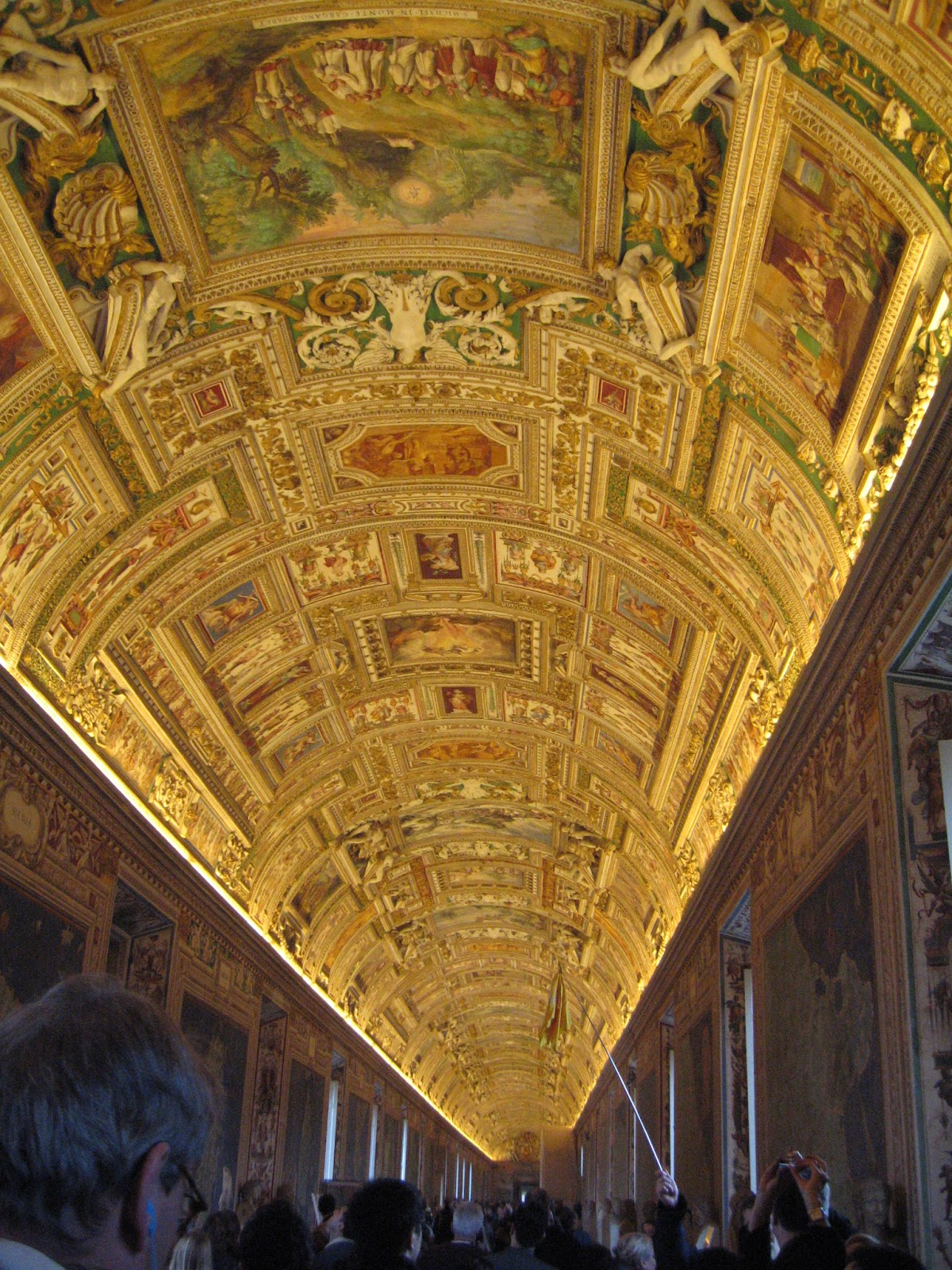
Remember what I said about looking up? Yea, look up in the Vatican Museum. Or guide was marvelous, and I truly mean that. He gave us wonderful accounts of and information about sculpture and mosaics, but he never once mentioned the ceilings. And let me tell you, there is some gorgeous stuff over your head in the Vatican Museum. Check it out.

And then there's the map room, which is 120 meters or roughly 394 feet long and 6 meters or just under 20 feet wide.
There are 40 topographical maps in this room which represent the regions of Italy as well as what the Church then possessed under Gregory X. What's so cool is that the maps are painted from the perspective of Rome. So the northern regions of Italy look fine, but the southern regions look upside down because they were drawn as though the painter situated himself in Rome and simply turned to see the southern regions. There was an episode in
Friends when Joey had to get in the map to see where he was to figure out where he needed to go. Seems like that wasn't such an original (or silly) idea.
At this point we had to make a decision to see the Raphael Rooms or go directly to the Sistine Chapel. Our guide was concerned we'd not get to the Basilica because it was closing early for final preparations for the 4:30P Mass. The majority opted for the Sistine Chapel and so off we went.
No pictures can be taken in the Sistine Chapel and guards who patrol the place regularly shush people when the noise gets too loud. Our guide gave us an extraordinarily complete tour of the works in the Sistine Chapel. His presentations were thorough and passionate; nearly evangelical, I might say.
When we left the Chapel, he took us to a place out of the pouring rain and gave some history and information of the Basilica itself--how long it took to build (150 years), why it's not the first St. Peter's, etc. People were anxious to return their sound systems and head into the Basilica. Originally I wasn't going to go in again--I saw the sign for the cupola and nearly. . . ., but I had to go see the inside again and noticed things I hadn't seen before. The immensity of the place makes it impossible to take it all in and I would imagine that would be true after dozens of visits.
And besides looking up in these places, it's often just as smart to look down. In this case, as you leave St. Peter's you just might see what might seem to suggest that the building and what it represents offers the keys to the eternal kingdom.
On the way home, walking very slowly in the pouring rain, stopping for a coffee on the way, I thought about what I'd seen and heard. I thought what I believe to be true about God and Jesus Christ. I thought about the Crusades and other religious wars as well as the current battles against the "infidel," which is a word that seems to mean "you don't believe the way I do and you should die." Oddly, perhaps, I thought about the pineapple and the peacocks, symbols that are supposed to represent hospitality and compassion. As I walked home I wondered how saddened God must be to see such remarkable work completed by those to whom He had given such talent. I wondered if He grieved over their motivation and if He rejoiced when they were moved by their inspiration to see, perhaps, a bit of the face of God.
At midnight I went to the
Chiesa del Gesu. I didn't understand a word, of course. I have to go back to get pictures as photography would have been inappropriate during a service. Though I didn't understand a word, I appreciated that venue because of the power of some of the artwork in that building, like the
Triumph of the Name of Jesus. . . on the ceiling. Of course there is magnificent art on the ceiling. Keep in mind where the most famous of Michelangelo's works resides: the ceiling of the Sistine Chapel. We look up to see those magnificent works that may or may not have been meant as inspired and devoted testaments to God. Even if they weren't, to see them we have to look up and be moved. . . by the work itself, by the gift of the artist, and perhaps by the God to whom and for whom they were created.


 From the Moses Fountain I went on to the Piazza della Repubblica because I wanted to visit what looked like a very old church. It is the Basilica of St. Maria of the Angels and Martyrs. Michelangelo was commissioned for this work by Pope Pius IV who wanted to consecrate the most monumental parts to the 40,000 Christians who were martyred. The basilica itself was built in what had been the Baths of Diocletian. "Michelangelo utilized the great central hall and some of the side rooms and succeeded in leaving intact the great sense of grandeur that the ancient building possessed without imposing his own architecture on the building." The great bronze doors were created in 2006 by the Polish-born sculptor Igor Mitoraj. There is an interesting history about the meridian line created in the basilica and the reasons for it. Some were scientific: the height of the walls, the building was already oriented towards the south, etc., but what might have been the more important and real reason was an opportunity to reinforce the dominance of the Christian calendar over the pagan calendar. It is a beautiful church and building. Some other reconstruction is going on to the right of the building, but it was difficult to tell what.